Research & Field Studies
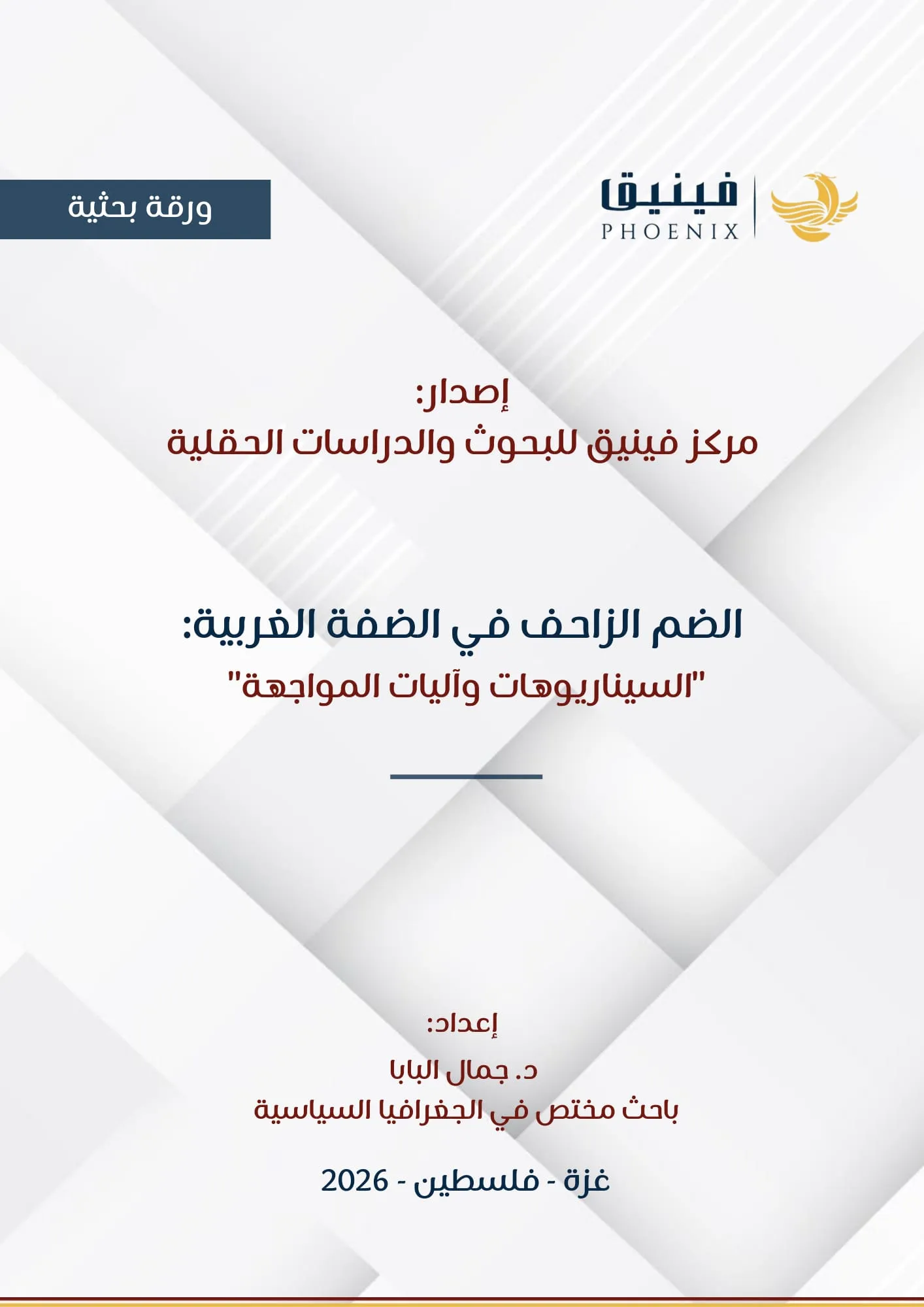
Creeping Annexation in the West Bank: "Scenarios and Mechanisms of Confrontation"
- Published
- February 28, 2026
Introduction
The West Bank is currently witnessing a profound strategic transformation represented by the acceleration of the "creeping annexation" track, as a cumulative policy based on introducing gradual legal, administrative, and security changes that reinforce actual Israeli control over the land without a formal declaration of annexation. Under the Israeli government headed by Benjamin Netanyahu, and pushed by prominent ministers in the ruling coalition such as Bezalel Smotrich, systematic work is underway to re-engineer the existing landscape in the West Bank through expanding settlement and legalizing outposts, reclassifying vast areas as "state land," curbing the powers of the Palestinian Authority, in addition to transferring civil powers from the military administration to Israeli ministries — reflecting a trend toward the "civilianization" of the administration of the occupation and transforming it into a more entrenched and permanent mode of governance.
The danger of these measures is not limited to their procedural or administrative dimension, but goes beyond that to reshaping the geopolitical and legal reality of the West Bank, through imposing new facts on the ground that make any future withdrawal more politically and security-wise complicated. This trajectory also reflects a shift from managing the conflict as an open negotiating file since the Oslo Accords, to an approach based on gradual decisiveness and the entrenchment of long-term control.
The decisions of the Israeli government regarding the expansion of settlement and the reformulation of legal systems in the West Bank raise profound legal and political effects, extending across the international, regional, and domestic levels alike, and these measures constitute part of what is known as creeping annexation, which seeks to gradually reinforce Israeli control over the land through administrative and legal changes, without a formal declaration of annexation.
The core problem stems from the fact that this trajectory places the future of the political settlement before a compound dilemma: on the one hand, it undermines the geographic and demographic foundations necessary for establishing a contiguous and viable Palestinian state, and on the other hand, it does not offer a clear political alternative that guarantees equal rights for Palestinians within any future entity, paving the way toward an unstable, long-term political reality. Accordingly, these transformations go beyond being mere administrative adjustments, constituting instead a redefinition of the very nature of the conflict, carrying within them grave strategic repercussions for the future of the West Bank and the settlement process in general.
Related Publications


The Demographic Conflict in Palestine from the Nakba to the War of Annihilation: "Policies, Challenges, and Outcomes"
March 16, 2026

Palestinian Women in Wartime: "Challenges of the Humanitarian Reality and Transformations in the Social Role"
February 2, 2026