Research & Field Studies
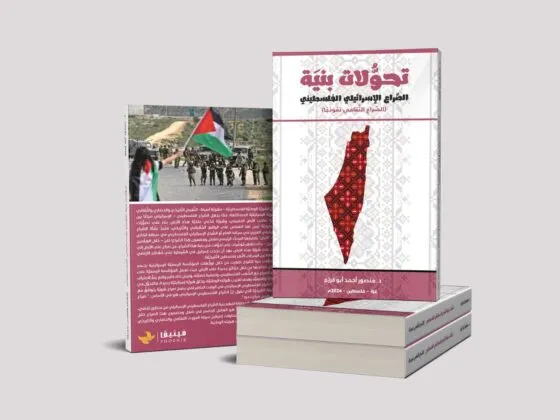
Transformations in the Structure of the Israeli-Palestinian Conflict After October 7 (The Cultural Conflict as a Case Study)
- Published
- April 6, 2025
Study Summary
A decade ago, the features of major transformations in the structure of the Palestinian-Israeli conflict began to appear, and these transformations were represented in the emergence of an extremist religious tendency following the rise of the religious right to power in Israel, after the Likud party led by Netanyahu took the reins of power in 2009, and Israeli society's drift toward the right and the religious right, which led to a conflict over the identity of the state and society inside the occupying entity, between the secular and the religious. As for the future of the Palestinian-Israeli conflict, these transformations have been reflected in the form and substance of the Palestinian-Israeli conflict, and have contributed to a decline in the chances of a political settlement through the two-state solution principle, in favor of reinforcing the security and military tendency in dealing with the Palestinian question, which has led to further killing and destruction.
The October 7 operation also reinforced the extremist tendency inside the Israeli entity, and contributed to increasing the intensity of the Israeli criminality practiced against the Palestinian people, whether in Gaza or the West Bank, without any international or regional capacity to deter it, whether through political pressure or judicial condemnations, and this was accompanied by the absence of any horizon for a political settlement based on the two-state solution principle, due to the decline in the United States' ability to play a pivotal role in the settlement process, and its acceptance of a nominal mediation that allows the occupation to reinforce an approach of managing the conflict, en route to a phase of decisively settling the conflict according to the vision of the extremist religious right.
The study showed the features and characteristics of Palestinian national identity that emerged as a reaction to the Zionist project, and the Zionist movement's attempts to erase its national identity, and also highlighted the features and characteristics of the true national identity as opposed to the imagined Israeli identity, and provided an explanation of the efforts of the ruling religious right in Israel to erase Palestinian national identity through the Nation-State Law, the Trump-era Deal of the Century plan, and the plan to decisively settle the conflict, which aims to prevent the establishment of any Palestinian political entity of any kind, and to expel or deport the Palestinian people.
The study explained Israel's attempts to steal the cultural, civilizational, and historical heritage of the Palestinian people within the framework of the identity conflict, represented in attempts to appropriate Palestinian dress and Palestinian and Arab cuisine, attempts to change historical landmarks and steal antiquities, and to change the names of cities and squares in the Old City of Jerusalem. It also showed the attempts of successive Israeli governments to impose a spatial and temporal division at Al-Aqsa Mosque.
The study showed the transformations in the structure of the Palestinian-Israeli conflict in its identity-based, heritage, and civilizational dimensions, and the reflection of these developments on the future of the settlement and the Palestinian land. Although the Palestinian-Israeli conflict originally arose as a conflict over land as a primary determinant, despite the importance of land to both sides, land no longer represents the governing framework of the Palestinian-Israeli equation, especially after the success of the Zionist project in controlling most of the Palestinian land, whether through wars or through settlement. It has become all but certain that the Palestinian-Israeli conflict is no longer a political conflict over ownership of the land, but has rather turned into a civilizational, cultural, and heritage-based conflict over the identity and ownership of Palestinian land, and ownership of its heritage, history, civilization, past, and future. This transformation in the structure of the Palestinian-Israeli conflict has also been accompanied by Israeli society's further drift toward the extreme right, which draws all its ideological, political, and cultural conceptions from religious biblical concepts that fuel the conflict, and transform it from a political conflict into a religious-civilizational conflict. The study affirmed the following recommendations:
- The importance of escalating the state of political, legal, and diplomatic engagement in international forums, in a way that enhances Palestine's standing on the international map, and affirms the Palestinian people's right to self-determination on their land, in order to confront the plan to decisively settle the conflict that targets the political existence of the Palestinian people and their right to self-determination.
- The necessity of working to expose the criminal Israeli practices that aim to decisively settle the conflict by exploiting the October 7 operation to kill and displace Palestinians from their land, through increasing the intensity of the crimes of the Israeli army and settlers, which aims to eliminate the physical, moral, and cultural presence of the Palestinian people.
- The necessity of affirming the importance of escalating popular resistance and popular diplomacy as tools for confronting the raging identity conflict between the Palestinian people and the Israeli occupation state.
- The necessity of confronting Israel's attempts to steal Palestinian cultural and civilizational heritage, by including Palestinian tangible and intangible heritage on the UNESCO list and those of other international organizations.
- Affirming the importance of exposing Israel's attempts to steal Palestinian antiquities to falsify history, through radio and television programs specialized in these fields.
- Affirming the importance of the legal approach in international forums to confront Israel's attempts to erase Palestinian national identity, by resorting to the United Nations, the International Court of Justice, and international organizations — especially UNESCO — to protect the cultural and civilizational heritage of the Palestinian people.
- Promoting the idea of popular campaigns on social media, and enhancing collective awareness regarding the use of street names in Arab cities, and not engaging with Jewish and biblical names.
- The necessity of registering Palestinian cuisine with UNESCO as tangible Palestinian heritage, to confront Israel's attempts to appropriate it and document it as part of its own civilizational heritage.
- The necessity of organizing festivals of Palestinian national heritage around the world to showcase Palestinian cuisine, dress, and folklore, to protect it from Israeli appropriation.
Related Publications
The Demographic Conflict in Palestine from the Nakba to the War of Annihilation: "Policies, Challenges, and Outcomes"
March 16, 2026
Creeping Annexation in the West Bank: "Scenarios and Mechanisms of Confrontation"
February 28, 2026