Research & Field Studies
The Christian Community in the Gaza Strip (Historical Status, National Role and Reality Challenges)
- Published
- February 18, 2025
News: Study Release
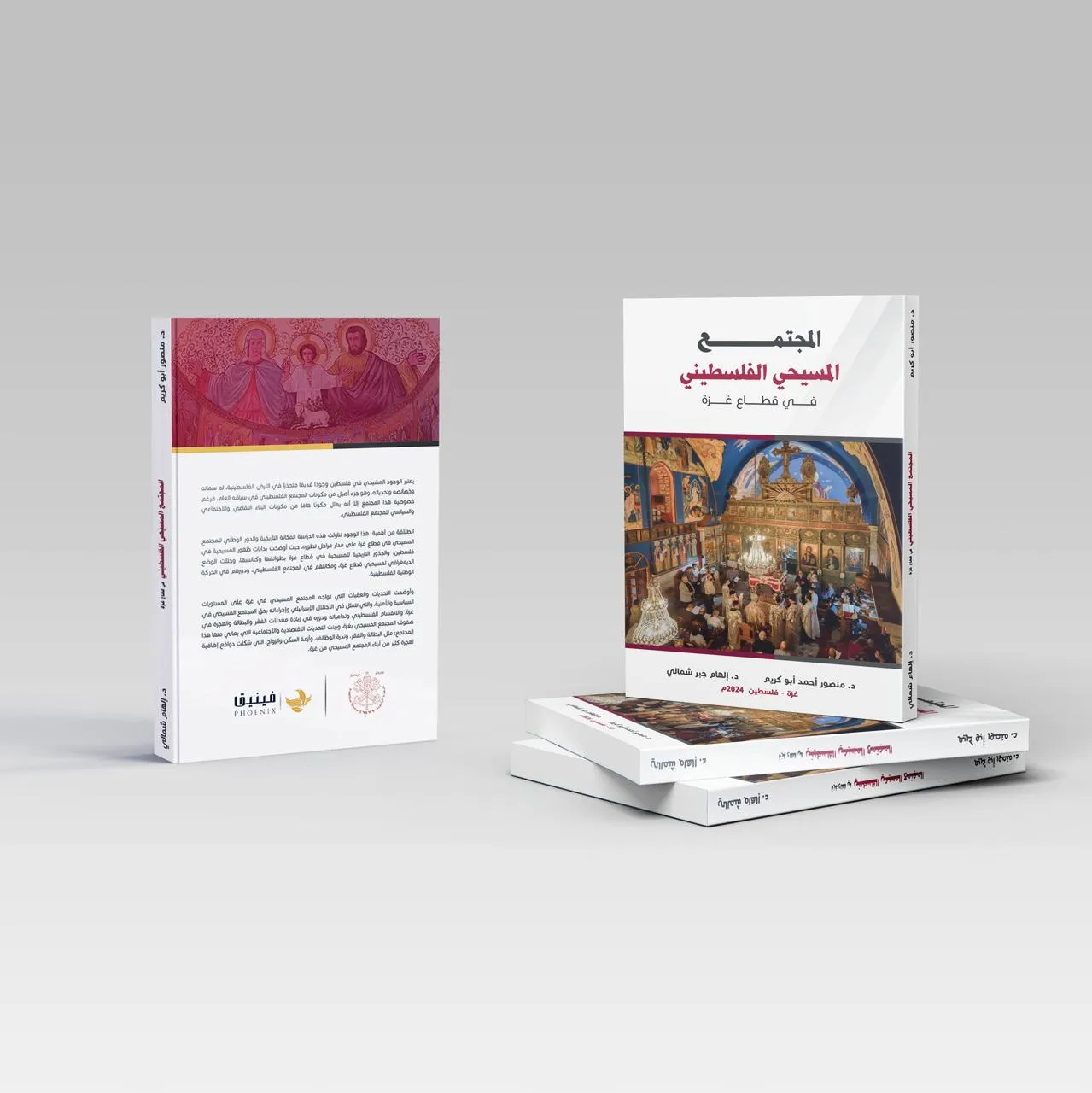
Phoenix Center for Research and Field Studies has issued an applied field study titled "The Christian Community in Gaza Between Historical Status, National Role, and Reality Challenges." The study, prepared by researchers Dr. Mansour Abu Kareem, a researcher in political affairs, and Dr. Elham Shamali, a researcher in modern and contemporary history, addressed the reality of the Christian community in Gaza from all aspects. The study, which was completed before the war and the Israeli aggression on the Gaza Strip, worked to clarify this community's status throughout history, and its national role in the Palestinian national movement. It also addressed this community's challenges from political, security, economic, and social aspects, and explained the reasons for the rising emigration rates among this community's youth, which were confined to reasons arising from the occupation's practices of wars and siege, which constituted a strong driver for the emigration of this community's youth, creating an age gap — in addition to the internal Palestinian conditions and the repercussions of the Palestinian division, the poor economic conditions, the scarcity of job opportunities, and the housing and marriage crisis.
The first chapter addressed the historical roots of the Christian presence in Gaza, with the study showing that this presence dates back centuries to the spread of the Christian religion, as Christianity entered Gaza in the fourth century, at the hands of Saint Porphyry, Bishop of Gaza (395–420 AD), who found 300 Christians in Gaza at a time when pagan temples and shrines were being demolished. The Church of Porphyry then marked the site of the temple at Easter in the year 407 AD, and churches, monasteries, and episcopal shrines were built along the coast of Gaza City.
The second chapter addressed the national role played by the Christian presence in Gaza in the Palestinian national movement, since the beginning of the Zionist project in Palestine, when numerous Christian national figures were at the forefront of resisting the Zionist project, continuing through its national role in the Palestinian national movement and the Palestinian revolution since its inception, as Christian Palestinian bodies and figures played a major role in the Palestinian national movement, and contributed to confronting the Israeli occupation after 1967, and participated in the Intifada of the Stones in 1987. The Christian community in Gaza offered numerous sacrifices, martyrs, wounded, and prisoners throughout the course of the Palestinian national struggle.
The third chapter addressed the Christian institutions in Gaza, with a comprehensive survey conducted of all Christian institutions and their religious, cultural, and social role. The study revealed the major role played by Christian institutions operating in the Gaza Strip in supporting the steadfastness of Palestinian society in general, and the Christian presence in particular, and their role in enriching Palestinian cultural and intellectual life, as these institutions work, driven by national, moral, and religious motives, to contribute to strengthening the steadfastness of the Palestinian people in Gaza, through health, educational, rehabilitative, and cultural programs, to build the Palestinian individual and strengthen their capabilities and develop their skills in all fields.
The fourth chapter addressed the political and security challenges facing the Christian community in Gaza, showing the challenges and obstacles facing the Christian community in Gaza at the political and security levels, represented by the Israeli occupation and its measures against the Christian community, and the Palestinian division and its repercussions on society and individuals, and their role in increasing rates of emigration and poverty among the Christian community in Gaza. The fifth chapter addressed the economic and social challenges, showing the most prominent economic and social challenges suffered by the community, such as unemployment and poverty, the scarcity of jobs, and the housing and marriage crisis, which constituted additional drivers for the emigration of many members of the Christian community from Gaza. The sixth and final chapter addressed the results of the survey study, in which a questionnaire and survey of all ages and groups was conducted through interviews and paper and electronic questionnaires. The study reached a set of findings and recommendations, the most important of which were as follows:
- The Christian community in Gaza suffers from a state of continuous decline in numbers, which warns of the possible extinction or significant shrinking of this presence in the coming years, as a result of numerous challenges and difficulties that have come to pose an existential threat to this community. Numbers declined from 1,688 individuals in 1997, to 1,375 individuals in 2007, to 1,313 in March 2014, while in the year of the study, 2023, the number does not exceed 1,025 individuals, as a result of emigration, natural death, low birth rates, and a rising age of marriage.
- The occupation and its arbitrary measures against Palestinian society and the Christian presence in Gaza are among the greatest challenges and obstacles facing the Christian community in Gaza, as the occupation works to fragment Christian families, prevents citizens from reaching the holy places in the West Bank, and hinders family cohesion and communication for many members of the Christian community in Gaza. The results showed that 85.97% affirmed that the Israeli siege is the greatest challenge facing the Christian presence in Gaza. 82.46% see the repeated Israeli wars on Gaza as posing a danger to their lives and the lives of their families, and as a driver of emigration. Regarding thinking about emigration in connection with Israeli measures of siege and wars, 38.59% reported that they think about emigration very seriously, while 73.69% reported that the Israeli occupation prevents the Christian community from practicing its religious rights as a result of Israeli practices of siege and wars.
- The continuation of the internal Palestinian division constitutes an obstacle to strengthening the Christian community in Gaza, as a result of the negative repercussions the division has left on the Christian presence in Gaza, represented by the absence of a sense of personal security due to numerous wrongful practices, and job insecurity due to the scarcity of job opportunities in Gaza. The results showed that 45.61% see the continuation of the division and the internal Palestinian crisis as a challenge to the Christian presence in Gaza. 49.12% see the absence of democratic practice and periodic elections as an obstacle to the involvement of members of the Christian community in political and social life, while 78.95% see the emergence of manifestations of religious extremism as posing a threat to the Christian presence in Gaza.
- The deteriorating economic conditions in Gaza create many problems for the Christian community in Gaza, as the results indicated that the deteriorating economic situation constitutes the greatest driver of emigration. 59.6% reported that the economic situation is the direct cause of emigration, in addition to the political and security situation, which came in second place at 52.6%. The results also indicated that 77.2% see unemployment and the deteriorating general economic situation as a driver for considering emigration, while 96.49% affirmed that poor economic conditions constitute a driver of emigration in general from Gaza, not only for the Christian community. 78.95% indicated that the housing crisis and the scarcity of jobs constitute the greatest challenge to strengthening the Christian community in Gaza.
The study also recommended a number of policies that would strengthen the Christian presence in Gaza, including the following:
- The necessity of joining official, popular, and civil national efforts to strengthen the steadfastness of the Christian community in Gaza, through adopting a comprehensive national plan whose formulation is contributed to by a specialized, integrated team (government, civil society, researchers) from within and outside the community, with the aim of improving the reality of this community and addressing its various challenges and crises, in a way that contributes to increasing this component's involvement in political and social life, and breaking the state of isolation.
- Working to raise the levels of political participation of members of the Christian community, by facilitating the involvement of youth in Palestinian forces and parties, in a way that contributes to increasing the participation of members of the Christian community in Palestinian political and social life.
- The Liberation Organization and the Palestinian Authority should work to allocate a proportion of public sector jobs to members of the Christian community throughout Palestine, and in the Gaza Strip specifically, by absorbing them into the institutions of the Liberation Organization and the ministries of the Palestinian Authority operating in the Gaza Strip, to ensure job opportunities for members of the Christian community and reduce emigration rates.
- Allocating 5% of the housing projects carried out by donor countries to members of the Christian community, to address the housing crisis, and to help form stable families, in a way that contributes to increasing numbers and reducing emigration rates.
Related Publications
The Demographic Conflict in Palestine from the Nakba to the War of Annihilation: "Policies, Challenges, and Outcomes"
March 16, 2026
Creeping Annexation in the West Bank: "Scenarios and Mechanisms of Confrontation"
February 28, 2026