Seminars
The Fourth Dialogue Meeting, Organized and Moderated by Phoenix Center for Research, Under the Title "Issue and Dialogue"
- Published
- April 23, 2024
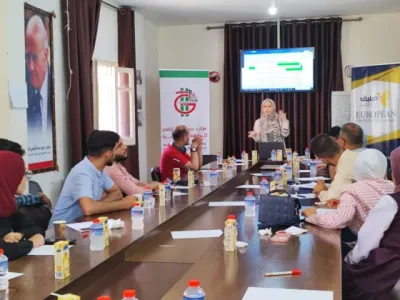
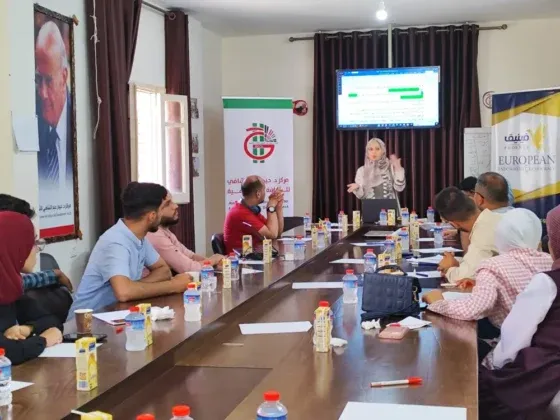
Phoenix Center for Research and Field Studies – Gaza University – held an intellectual dialogue seminar within its program "Issue and Dialogue"
titled "The Succession to President Abbas Between National Consensus and Regional and International Interventions."
Center Chairman Dr. Khaled Alyazji welcomed the attendees, inviting them to deepen the processes of thinking and inquiry in the course of the dialogue, with the aim of arriving at scholarly and informed visions and conclusions that help build the political scene and reduce the intensity of improvisation and experimentation.
Mr. Nasser Elewa, Director-General of Phoenix Center, then thanked the attendees — thinkers, writers, faction representatives, civil society activists, and journalists — for their responsiveness in contributing to the dialogue session.
Mr. Nasser Elewa presented a set of questions in order to structure and enrich the dialogue, and these questions came within the context of the topic under research and discussion and what flows from it in terms of assessments, determinants, and assumptions.
Among the parameters of the dialogue, the Center's Director raised the following questions, with the aim of opening up further ideas and deepening the understanding of the seminar's topic, in order to arrive at a formulation of a governing vision for shaping the future political scene in Palestine.
The questions, assumptions, and inquiries came as follows:
First: Did President Abbas predetermine the political scene after him by disabling, emptying, and dismantling the legislative, judicial, and political institution?
Second: Did President Abbas work to engineer a political system based on one-man and inner-circle rule, thereby providing a model of the dictatorial ruler and establishing a system of governance through corruption and corrupting others?
Third: Has the contagion of dictatorship and cronyism-based administration spread to the political system in its comprehensive sense, with all its components — parties, unions, civil society bodies, economic and productive institutions?
Fourth: Amid the state of division that the era of President Mahmoud Abbas has witnessed, does his absence constitute an opportunity to rebuild national consensus, beginning with agreement on comprehensively rebuilding the political system through the mechanism of democratic action and elections?
Fifth: Amid the absence of national consensus and regional and international interference in choosing President Abbas's successor, could we reach a state of political chaos and conflict between power centers and influential figures within the Authority?
Sixth: After President Abbas dismantled the Fatah movement and rebuilt it according to a system of loyalty based on inclusion and exclusion, will Fatah be able to reclaim its political role after having become a ruling party in a dictatorial form, and will this movement later have a role in determining and renewing the Palestinian political system — and accordingly, must the next successor to President Abbas necessarily come from within Fatah's ranks?
Seventh: How do Hamas and the factions close to it view the choice of President Abbas's successor in light of the complications arising from the dismantling of the political and legal system, and accordingly, will Hamas pursue any of the following options:
- Entering into a power-sharing process with Fatah to divide the political system — the national authority, the Liberation Organization, and their affiliated institutions.
- Hamas taking a radical stance and insisting on rebuilding the political system through a comprehensive electoral process.
Eighth: The role of regional axes and international centers in determining the mechanism and identity of President Abbas's successor.
- The Israeli role: the scale of this role, its influence, and its relationships that allow it to play a central role in determining President Abbas's successor.
- The Egyptian-Jordanian role, coupled with Gulf backing (Saudi Arabia, Qatar), in agreement or conflict with the Israeli position.
- The Turkish and Iranian positions, followed by the position of the Muslim Brotherhood movement and the extensions of Iranian influence.
- The American-European position and its impact on regional positions.
- The impact of direct American and European influence on the various Palestinian parties.
The honored attendees discussed some of these questions from multiple points of view that enriched and enlivened the dialogue and generated further questions and inquiries. Mr. Wajih Abu Dharifa summarized his view by linking the necessity of coupling a change in the political system with bringing about change in the national program, so that we bring about a shift in the structure of the political system as a whole, and change should not be limited to the head of the political system. Mr. Abu Dharifa noted the danger of regional and international interference seeking to keep the political system in its current state by providing material and political support with the aim of keeping the crisis and its escalation within the Palestinian arena. Mr. Abu Dharifa also indicated that Fatah and Hamas are both moving in a project of reinforcing the division leading to separation, and Mr. Abu Dharifa concluded by saying we are heading toward non-agreement regarding rebuilding the political system.
Mr. Mohsen Abu Ramadan noted that the structure of the Palestinian political system is divided between the Palestine Liberation Organization and the Authority, and this will lead to a dispute over legitimacies, resulting in the absence of any unifying Palestinian banner, after the institutions of the Liberation Organization have been emptied of their struggle-based and representative substance. Mr. Abu Ramadan also warned against Israel's attempt to take us back to square one through projects of annexation, racial discrimination, and settlement, and Mr. Abu Ramadan concluded by calling for a return to the Palestine Liberation Organization as a broad national front capable of leading the Palestinian people, and called for a return to the electoral base through which the political system would be renewed.
In a focused intervention, Mr. Taysir Muheisen presented his view by linking the dynamics of the development of the Palestinian condition and the political system to the management of the conflict with Israel, and Mr. Muheisen considered that the era of President Abu Mazen ended in 2008 — President Abu Mazen came to manage the dysfunction in the political system, which was suffering from the disintegration and fragmentation generated by Yasser Arafat's leadership. Mr. Muheisen considered that the period after 2008 is the period of incapacity that afflicted the Palestinian political system in general, and added that the absence and marginalization of the idea of statehood and identity expressed by the Palestine Liberation Organization has led to threats that have gone beyond the political system to the political existence itself, and Mr. Muheisen concluded by saying that any single faction's monopolization of managing the political system constitutes a real threat to the Palestinian people's remaining on their land.
Mr. Osama Al-Hajj Ahmed then presented his view on the reality of the current political system, saying there is no legitimacy for any of the components of the political system, whether regarding the institutions of the Liberation Organization or the institutions of the Authority, adding that external interventions are what will determine the head of the Palestinian political system, noting that Israel and the United States are the ones leading the process of determining the identity of the Palestinian president. He added that a majority of the Palestinian people believe that the Palestinian presidency should be from Fatah and that the president must be a Fatah member, and Mr. Osama Al-Hajj Ahmed called for the necessity that the president represent the Palestinian people as a whole, and called for the necessity of arranging President Abbas's succession before his departure through the Palestine Liberation Organization with the consensus of all Palestinians on the person of the president, adding the necessity of holding a comprehensive national dialogue leading to consensus on holding comprehensive elections.
Mr. Salah al-Din Abu Rukba noted in his intervention the absence of a political system capable of producing a successor to President Abbas, considering that the division prevailing in the Palestinian arena obstructs any process of national consensus on choosing a successor to President Abbas. Mr. Salah al-Din Abu Rukba estimated that the Palestinian predicament will deepen and continue into the future, and noted that elections, despite their importance, do not lead to reforming the political system, and Mr. Abu Rukba warned of the danger of internal conflict in the West Bank, which could lead to armed clashes between the warring wings of Fatah, which, according to him, have begun preparing for a possible wave of bloody conflict. Mr. Abu Rukba concluded his intervention by calling for the activation of the Palestine Liberation Organization as a safe way out of the crisis of succeeding President Abbas.
Mr. Ashraf Dahlan, for his part, denied the existence of something called a political system in Palestine, and considered that the concept of a political system does not apply to the Palestinian case in all its components, and pointed to the reality of separation and division between the West Bank and Gaza and the areas where Palestinians reside elsewhere, adding that President Abu Mazen engineered the Palestinian political system according to his own requirements, and through this engineering allowed for intervention by various regional and international parties. Perhaps the most prominent feature of this engineering is the division that has turned into separation — a separation that will give both Fatah and Hamas freedom of action without any restraints after the stage of President Abbas: Fatah could elect a president, while Hamas, in turn, would not accept this outcome and would demand a return to the Basic Law. Mr. Ashraf concluded his intervention by saying everyone is working to reinforce the division and everyone seeks to preserve their own share.
Mr. Rabie Abu Hatab noted that the Palestinian political system has historically been a regional and international construct, with no trace of the will of the Palestinian people within it, and what is coming at the level of the political system will not go beyond the concept of the village leagues in a renewed form called the "greater village league," described as a government with political powers headed by a person who is not a subject of dispute and who enjoys the support of the international and regional community.
Mr. Abdullah al-Aqqad said that President Abbas has succeeded in reducing the political system to his own person and is working hard to sideline any alternative, which will lead to a multiplicity of options, perhaps the most prominent being the option of national consensus on the person of the next president, a consensus to be sealed through the electoral process. Mr. Abdullah al-Aqqad noted the existence of serious attempts to announce the formation of a united national front in order to try to fill the vacuum resulting from the expected chaos after President Abbas's absence, and to confront Israeli interference in Palestinian affairs.
Mr. Salah Abdel Ati pointed to the deep national predicament suffered by the Palestinian arena, given the existence of two opposing programs — the resistance program and the negotiation program — and Mr. Abdel Ati called for abandoning the conspiracy-theory mentality that claims Israel decides everything for the Palestinian people, and Mr. Abdel Ati warned of the existence of an Israeli plan to spread chaos in the West Bank, in addition to the necessity of paying attention to regional interventions coming from neighboring countries, and Mr. Abdel Ati concluded his intervention by pointing to the absence of a unifying model based on a program of national partnership and collective leadership.
In closing, Dr. Khaled Alyazji thanked the participants for the valuable interventions they presented, affirming the necessity of continuing the approach of scholarly dialogue necessary for overcoming the great national predicament.
Prepared and edited by Mr. Nasser Elewa
Related Publications
Phoenix Center Holds a Dialogue Session on the Repercussions of the Israeli Election Results and the Expected Government on the Gaza Strip
April 23, 2024Dialogue Session: Approaches to the Open Conflict in Jerusalem and the West Bank with the Occupation Authorities
April 23, 2024