

Case Assessment
Position Assessment Paper: Jerusalem — From Civil Disobedience to National Disobedience
- Published
- April 24, 2024
The shifts in the policy of the Israeli right-wing government, led by Benjamin Netanyahu, along with extremist religious and nationalist party blocs, have led to the opening of new windows in the conflict between the Palestinian people and the Israeli occupation authorities. This opening has placed us on the threshold of a new era, one with characteristics and tools that enable a qualitative opening of a new phase of conflict onto renewed horizons, within the context of its own particular conditions and everything the current and future historical and political moment entails in terms of requirements and necessities — added to this is the accumulated experience of the Palestinian people's struggle, with both its setbacks and its achievements. This accumulated experience takes shape according to the will of the Palestinian people, who through their long experience have learned how to build and structure their struggle in line with their needs, and in a manner suited to confronting the administrations and tactics of the occupation authorities and its racist approach.
The announcement by the people of Jerusalem of civil disobedience in the face of the policies of the Israeli right-wing government came as a cumulative act, some of whose features had matured and whose elements had crystallized in the course of the long conflict in and over Jerusalem — a city that, by its very nature and history, constitutes the center of the conflict with the occupier. Likewise, Jerusalem's hold on its special status carries the secret and the greatest riddle of the conflict: Jerusalem, and Jerusalem alone, is what determines and will determine the dimensions and horizons of the conflict — not as beginnings or endings, but as tools and programs from which the Palestinian people forge their experience of struggle.
Related Publications
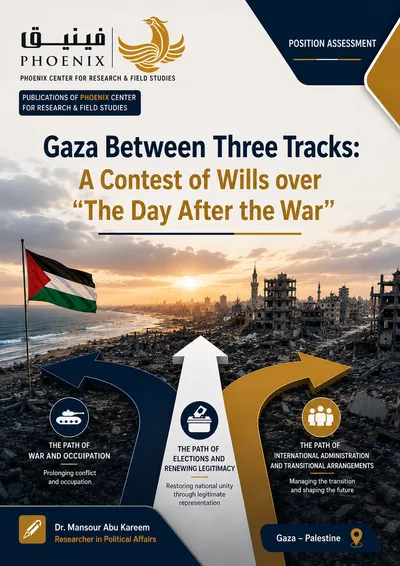

Gaza Between Three Tracks: The Battle of Wills Over "The Day After the War"
August 6, 2026

American-Israeli Disputes Over Managing the Second Phase in Gaza: "A Clash of Visions or a Division of Roles?"
February 28, 2026